LE MAG
Thématiques
Dernières publications



The EPR for household packaging applies to all organisations placing packaged products consumed or used by households on the French market. It makes them responsible for managing the end of life of such household packaging. It includes collection, sorting, recycling and reuse, as well as eco-design and consumer awareness-raising.
It can apply to you as a producer, importer of goods onto the French market, or the first to place packaged products targeted at households on the French market.
Watch our video to find out more.
If you fall into one of the above categories, EPR applies to you and you will need to join a producer responsibility organisation (PRO) such as Citeo, which takes care of managing and financing the end of life of your household packaging.
As a reminder, Citeo is a not-for-profit organisation which invests all the contributions made by its clients into managing the end of life of packaging.
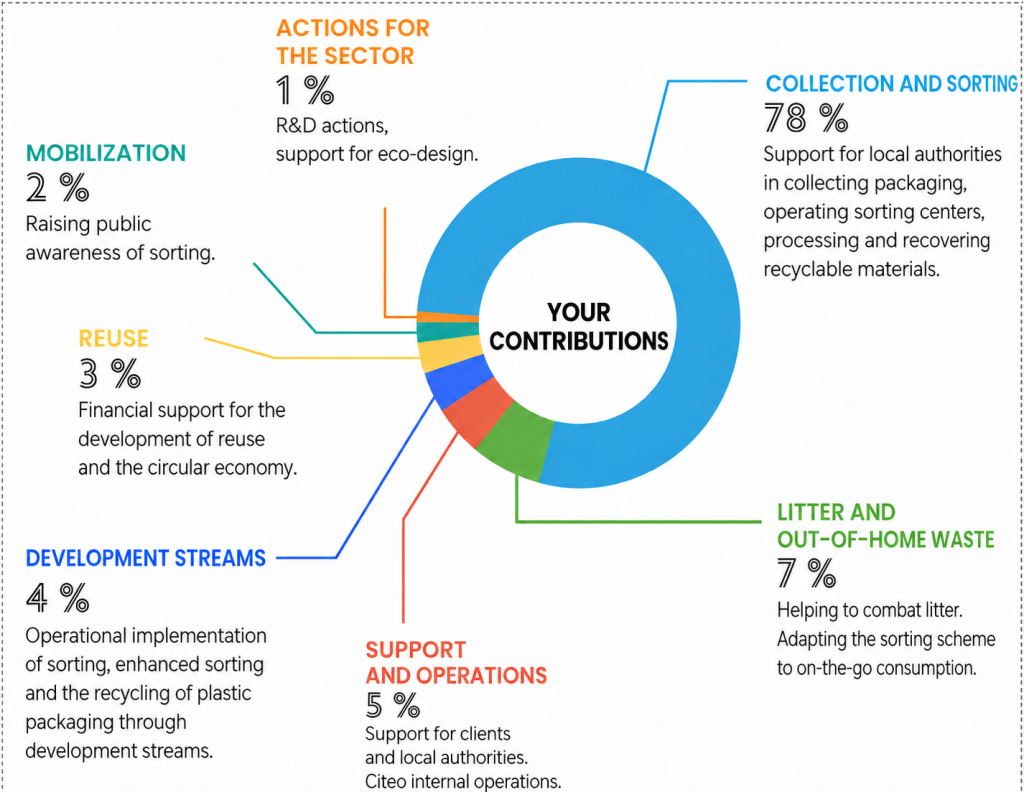
How each euro paid to Citeo is spent:
Citeo is also the approved producer responsibility organisation for the graphic paper EPR scheme.
To find out if graphic paper EPR applies to you, please go to section 5 below (+ link).
Those who place packaged products on the market are responsible for declaring their packaging, i.e. the organisations that package their products with the packaging supplied to them.
It is up to your customers to join Citeo. They will then have access to all the necessary document and files, which they can forward to you so that you can label the packaging you supply accordingly.
However, if you also sell B2C products directly to households, you will need to join a producer responsibility organisation to declare the packaging related to this activity in particular.
Thirty years ago, Article L.541-10 of the French Environmental Code introduced the principle of EPR for household packaging.
This legislation obligates businesses placing household packaging on the market to set up a system, alone or with others via a state-approved producer responsibility organisation, for processing the waste produced by their products. The system should include a collection, sorting and recycling process.
Watch our video on EPR for household packaging to find out more.
Since 1 January 2022 you should have been issued with a unique identifier generated by the French agency for ecological transition (ADEME).
This unique identifier is proof that a company subject to EPR pays its producer responsibility organisation contributions. It must therefore be included in your T&Cs and any contractual documents.
According to Article L541-9-5 of the French Environmental Code, companies to whom EPR applies but who are not members of a producer responsibility organisation, and do not therefore have a unique identifier, can be fined up to €30,000.
Once your membership has been confirmed, Citeo will send you a unique identifier within eight days. The identifier will also be made available in your customer space.
The unique identifier is specific to each EPR scheme. This means that if, for example, the household packaging , paper and textile EPRs all apply to your business, you will need to obtain three unique identifiers – one from each producer responsibility organisation.
To obtain your unique identifier immediately, you will need to select the current year as the first year of membership. Please note that if you select the following year as the first year of membership, you will only receive your unique identifier the following year.
You will need to forward your unique identifier to the marketplaces you work with (e.g. Amazon, Cdiscount, UberEats, Deliveroo, etc.), in other words, the platforms you use to sell your products online.
Since early 2022, these marketplaces have a duty to check that all third-party sellers using their platform are members of a producer responsibility organisation and fulfil their EPR obligations.
If you do not provide them with your unique identifier as proof that you are a member of a producer responsibility organisation, they have to declare and pay your packaging contribution on your behalf. This means they have the right to apply a specific fee to each of your orders. Some marketplaces ask sellers to obtain a unique identifier before allowing them to sell products via their platform.
You start declaring your packaging from the 1 January of the year your membership starts. Since the Order of 5 May 2017, the obligation to declare packaging from the three previous years is no longer applicable.
If you do not fulfil your obligations, your company could be issued with an administrative fine of up to €7,500 per tonne or per product unit concerned (in accordance with Article L541-10-11 of the French Environmental Code).
You can join online in a few clicks. Simply enter all the contact details of the company and Citeo’s point of contact at the company, as well as the details of the contract signatories.
If you decide to go through a service provider to manage your contract, the latter will need to present a management mandate or a power of attorney, as necessary.
The contract is signed online. You will then receive confirmation of your membership within a few days.
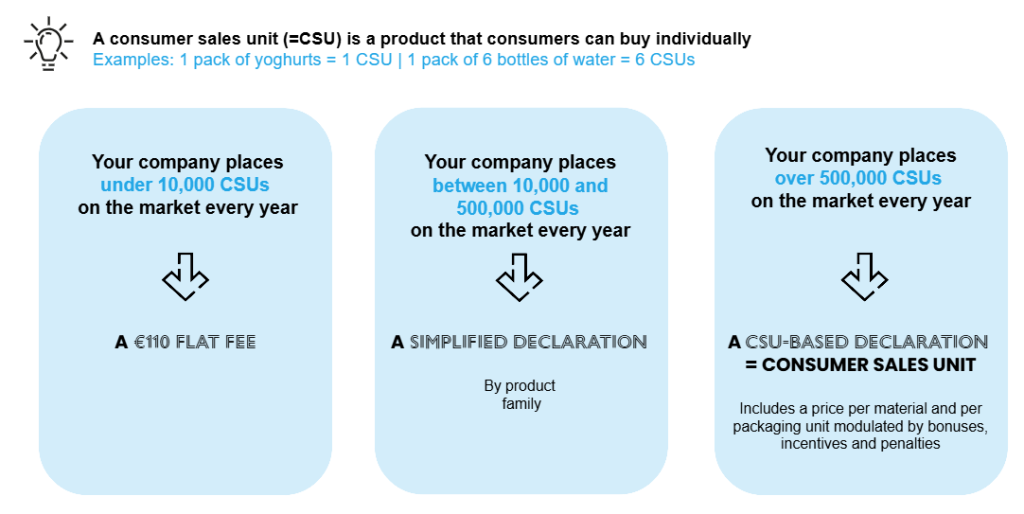
The amount you pay depends on the quantity of packaged products (also known as consumer sales units or CSUs) you sell to households in France.
Citeo offers three types of declaration based on that quantity or volume:
If you have any other questions about the rate, you can ask our Customer Service teams for a simulation by sending an email to citeo@citeo.com
Once you are a member, you will be able to access our various declaration simulators for each of the three declaration types offered (per CSU, simplified with shipping boxes, or without).
You can carry out as many simulations as needed to choose the best option for you.
Each declaration offers different advantages – you are free to decide which best meets your needs and budget.
Once you become a member, you receive a provisional invoice of €110 excl. tax.
The period taken into account for packaging placed on the market runs from 1 January to 31 December. You have from 1 January to 28 February of the following year to declare your packaging. An adjustment invoice will then be sent to you based on your declaration.
E.g. for packaging placed on the market in 2026, the declaration period is January-February 2027.
After that, for annual contributions of over €5,000, you receive quarterly provisional invoices that are based on your last declaration. You then receive an adjustment invoice at the start of the following year, once you have declared your packaging.
For contributions of under €5,000, invoices are issued annually and paid in December.
o be able to join a producer responsibility organisation, you must have a VAT number if you are based in the European Union.
If you are a private individual, packaging EPR does not apply to you.
However, it applies to you if you are an auto-entrepreneur. You can request a VAT number even if your business is exempt from VAT. Obtaining this VAT number does not affect your tax situation.
You can request a VAT number via this government website: https://entreprendre.service-public.fr/vosdroits/R38712
If you are part of a group, you have two options.
Option 1:
The group joins on behalf of all its subsidiaries. At account creation, simply indicate that you are acting as an Agent and list all the subsidiaries (or franchises) covered by the contract in the list of principals. It means you only have to provide one declaration for all the listed subsidiaries (or franchises).
It also means that you benefit from a centralised support hub for your entire network, with access to all Citeo’s expertise on various topics (regulatory watch, declarations, communication, tools and services).
However, it implies collecting all the information on the packaging placed on the market by your various subsidiaries (or franchises).
Option 2:
Each subsidiary or franchise joins Citeo individually. They will then be responsible for their membership, filling out declarations and paying the contribution(s) linked to their specific business activities.
First case: original packaging for second-hand products coming from France
If you sell second-hand products in their original packaging (e.g. shoebox, cell phone packaging, etc.), you do not need to declare the primary packaging of these products. The responsibility lies with the producer of the packaging when it was first placed on the market.
Second case: original packaging for second-hand products coming from abroad
If you are based abroad and sell to French consumers second-hand packaged products in their original packaging (e.g. shoe boxes, cell phone packaging, etc.), you are responsible for declaring them as you are considered as the first importer of the packaging into France.
Third case: reused shipping packaging
Whether you’re based in France or abroad, if you reuse cardboards or any other type of packaging for a shipment, you must declare them, unless you can trace and justify that they have been declared when they were first placed on the French market.
Fourth case: loose sales (products sold in bulk)
If you sell 100% bulk products without any packaging, you don’t have to declare anything. For example, if your customers systematically bring their own containers to transport your products.
Be careful to ensure that no associated elements are considered as packaging. Packaging potentially includes anything that can be thrown away when the product is opened or consumed, whatever its material is. Examples of packaging include, but are not limited to: labels, ties, string, kraft bags, cling film, etc.
Beyond enabling you to fulfil your regulatory obligation, your contribution gives you access to numerous benefits.
Here are a some of the services and solutions included in your contribution and made exclusively available to you on becoming a member:
LESS: A methodological guide with resources to help you reduce your packaging volumes;
TREE: A tool for testing the recyclability of your packaging and identifying which compulsory recycling information needs to appear on your packaging;
Citeo is on hand to help its clients with eco-design, offering numerous tools and services (LESS, TREE) and the assistance of its team of experts.
Helping our clients implement their packaging and innovation strategies are two key drivers for the success of our road map..
The notion of “graphic paper” applies to all papers weighing less than 224 g/m².
The paper products concerned include (non-exhaustive list): brochures, leaflets, catalogues, magazines, newspapers, mailings, headed paper, management documents, envelopes, posters, user manuals, decorative paper, receipts, tickets, etc.
Blank paper is declared directly by the paper mills manufacturing it.
The EPR applies to you if you place “graphic” paper on the market, or, in other words, you ask a printer to print out a paper product for your company’s use. If that is the case, you are responsible for declaring the paper volumes and paying the corresponding contribution.
The EPR also applies to companies who import or resell printed or blank paper products in France (i.e. those who are the first to invoice French VAT).
The paper EPR applies regardless of the volume. As soon as you place any paper on the market, you have to join Citeo, the only producer responsibility organisation approved for paper by the French state.
You can join via Citeo’s client portal: https://clients.citeo.com/fr/public/registration/papers
Yes, the scheme covers both perimeters. If you are not concerned by packaging or vice versa, you simply need to indicate this each year when you submit your declaration.
If you join today, you will need to declare any paper placed on the market over the three last years, regardless of the volume.
Under five tonnes, you don’t pay anything.
Over five tonnes, the rate is updated every year. For paper placed on the market in 2022, the base rate per tonne of paper is €94 excl. tax.
Depending on the type of declaration chosen (simplified or detailed), the rate may be adjusted upwards or downwards..
Even if you place less than five tonnes of graphic paper on the market annually, you still need to join because having a unique identifier is compulsory. The unique identifier needs to be transmitted to the marketplaces you use to sell your products and also needs to appear on all contractual documents and T&Cs.
You also need to join to access all the information on adding Sorting Info to your graphic paper products..
For a restaurant, the obligation concerns single-use packagings used for on-site consumption, take away or delivery.
1.Take away or delivery :
The packagings of products sold for take away or delivery are concerned by EPR and therefore must be declared. Here are a few examples : a plastic bowl and its lid, a burger paper wrap, a beverage cup and its lid, a take-away bag, etc.
2.On-site consumption :
If you have already implemented the sorting of waste in your restaurant (decree called “5 flows” or decree n°2016-288 of March 10, 2016) with the associated selective waste collection and your customers are clearly and visibly informed of the right sorting gesture adapted to your waste collection system : the packagings of meals consumed on-site are not concerned by EPR and are therefore not to be declared.
If you have not set up a sorting or selective collection system in your restaurant, the packagings of products consumed on-site are concerned by EPR.
You must then join an eco-organization such as Citeo which will manage and finance the end of life of your packagings.
It is therefore necessary for you to be able to track and quantify the different flows of your packaging : “take-away”, “delivery” and “on-site consumption”..
If you have a chain of integrated restaurants, you can sign one single contract for your entire network and declare their packagings at once.
You will only need to indicate when registering on Step 6 of the registration process that you are acting « in your own name and on your behalf ».
If you are a member of an integrated restaurant chain, it is the headquarters of the restaurant chain which must register at Citeo and declare the packagings for the whole network.
If you belong to a franchise network, you have two options:
Option 1 (recommended by Citeo):
The franchisor joins for the entire network including the franchise network, if your franchisees agree to delegate the management of the contract with Citeo to you (membership, declaration, contribution payment).
Option 2:
Ask your franchisees to join Citeo individually.
They will be responsible for their own membership, declaration and payment of the contribution, related to the activity of their stores only.
You will then have to send to your franchisees the packaging specifications so that they have all the information they need to complete their declaration.
The UIN must be communicated to the delivery platforms you collaborate with.
Indeed, since the beginning of 2022, as marketplaces*, these platforms are required, to verify that all third-party restaurants and vendors who use their platform are registered to an eco-organization and that they fulfill their EPR obligations.
If they do not have the guarantee, through your UIN, that your restaurant is a member of an eco-organization, they are required to declare and pay the contribution for your packagings on your behalf.
A specific rate per order and per type of restaurant (streetfood, American, Japanese, burger, Italian, French, other) can be applied by the marketplace on each of your orders.
Indeed, Citeo has developed a specific rate adapted to the online food delivery marketplaces (see the simplified declaration with shipping package).
The delivery platforms only declare the packagings for the sales made through their own platform and for which the restaurants do not declare directly to the relevant eco-organisations.
Thus, if your restaurant makes deliveries via other platforms, has take away sales or on-site sales (without sorting or selective collection at the point of sale), you are entitled to pay the contribution for these packagings..
In this case, there are two possibilities:
1. You do a new registration, separate from the first one (there will therefore be two contracts, two declarations and two separate UINs)
2. You add this new restaurant into your initial contract (there will be only one contract, one annual declaration and one UIN common to both stores)
You must go to the “Contract & profile” tab and then click on the link (pencil picto) to the contract renewal process..
Household packaging EPR has been existing for 30 years, and only concerns packaging used by private individuals, referred as “household” (take away sales, deliveries, some on-site sales) – see details in question 1.
Catering EPR will only come into effect from 2023, the exact scope is not yet fully defined, but it should concern packaging discarded in the “back room”, meaning the packaging of products used by professionals (bars, hotels and restaurants as part of their catering activity).
Examples : large bottles of drinks, tins of pasta, canned vegetables, 5-litre jars of mustard, etc.
A marketplace is defined as a digital platform, portal, or other similar online presence used by third-party sellers to sell their products to customers remotely, and through which they can also ship their products.
Since early 2022, EPR obligations apply to marketplaces. If you are a marketplace, you now need to declare the products sold by the sellers using your platform who have not provided a unique identifier.
If your sellers have a unique identifier, you simply keep an up-to-date register of these unique identifiers. You do not need to declare their packaging or paper volumes.
You are free to remind your sellers of their obligation to contribute to an EPR scheme.
We are on hand to help you fulfil this new obligation and make the right choice for your organisation. Why not get in touch by sending an email to citeo@citeo.com – don’t forget to tell us that you are a marketplace operator. An expert will then contact you as soon as possible.
A search engine is available on the specific website managed by ADEME, enabling you to find the owner of a unique identifier and check its validity. As a marketplace, you can request specific access to this ADEME website to make it easier for you to find your sellers’ unique identifiers. Citeo can help you obtain this specific access.
You need to be able to show that the third party sellers using your platform to sell products are fulfilling all their EPR obligations (e.g. packaging EPR, paper EPR, etc.).
That is why you need to keep an up-to-date register of your third-party sellers, containing the following information:
The number of packaged products they sell (via your marketplace)
Information about the seller’s identity
Their unique identifier for each EPR scheme
A specific declaration (limited to 500,000 packaged products sold annually per seller) has been exclusively created by Citeo, called the simplified declaration including shipping boxes.
It is intended to make declarations easier for you and your sellers. It has been approved by the public authorities and guarantees compliance with your marketplace obligations.
This simplified declaration is made up of 64 product families with a specific rate for each family. It integrates the product’s packaging directly, along with the shipping or delivery packaging.
Citeo offers two options for service providers:
In any case, you should always identify yourself when you take out the membership on behalf of your customer.
We advise you to contact us beforehand by sending an email to citeo@citeo.com. Don’t forget to tell us that you are a service provider so that we can be on hand from start to finish.